
Sometime after the death of my father, I was helping my mother clean and stumbled upon a small, square bubble mailer addressed from me to my sister, Jenni. The package was open, but the contents looked as if they were untouched, and in order, which contained the entire sermon series of my former pastor, Wayne Goranson, on Philippians; a sermon from my mentor, Tony Didlo; and three sermons from Scott Evans — now Pastor of Calvary Chapel Camp Verde, Arizona.
As I stood in my mother’s bedroom, I slowly unfolded the letter and read. I was so filled with hope and joy about sharing a part of my life with her when I wrote it. I wanted her to experience all that I had in Christ, despite her getting mad at me about bringing up “religion” in previous months. I was so young in the faith, but zealous for Jesus. However, reading it many years later, my heart sank as I realized, unknowingly at the time of sending it, she would be gone in less than a year.
Having your evangelism efforts disregarded can be very discouraging, especially when we have the cure for a lot of their problems, not just their eternal problem. It can feel like you’re putting all your energy into something that doesn’t seem to have much impact. But here are a few things to consider when your evangelism efforts fall on deaf ears.
Keep Praying
First, before everything, you should be praying. In an article by Will Graham, he told of two things his grandfather wished he would have done differently. The first—pray; the second—study. He continued:
“I wish I knew the Bible as well as your grandmother. She knows it better than anyone I have ever met. And we could have done so much more if we had taken fewer speaking engagements and spent more time on our knees in earnest prayer.”1
If you are trying to do this in your own strength, then yes, you will feel exhausted. Everything we do should be done through prayer. Communicating to the Father and asking for guidance, direction, to make your heart right, should be done throughout our lives. Here are a few things to pray through:
- Pray to interceed on behalf of the lost because the Savior desires all to be saved and come to the knowledge of the truth (1 Timothy 2:1-5).
- Pray for open doors to share the gospel (Colossians 4:2-4).
- Pray to speak the gospel boldly (Ephesians 6:18-20).
- Pray that God would be glorified and be protected from evil (2 Thessalonians 3:1-4).
- Pray for right words to say that our message would be clear and from the Holy Spirit to persuade men to come to Christ (1 Corinthians 2:4, 5:11; Acts 19:8, 28:23).
- Pray that the lost would come to their senses and escape the snare of the devil (Acts 26:18; 2 Timothy 2:25-26)
- Pray the Lord of the harvest would send more laborers into the fields to share the gospel (Luke 10:2).
- Pray always and not give up (Luke 18:1-8).
Check out this article from Got Questions about praying for the unsaved.
Be Patient
Patience and endurance are keys to helping you move forward when your ministry feels stale. Farmer’s do not rejoice when the seeds are sown, but when the crops are ready for harvest. But the harvest takes time and plants don’t grow overnight. With many other things needing to be done. There is tilling the soil, watering, weeding along with much sunlight that allows the crops to grow.
Therefore be patient, brethren, until the coming of the Lord. See how the farmer waits for the precious fruit of the earth, waiting patiently for it until it receives the early and latter rain. You also be patient. Establish your hearts, for the coming of the Lord is at hand.
James 5:7-8 NKJV
The apostle Paul said in Galatians 6:9, “…let us not grow weary while doing good, for in due season we shall reap if we do not lose heart.” Let us reap a plentiful harvest for the Lord as we go out and share the gospel to a world that desperately needs Him.
Model the Message
Children learn by observation and imitation. From a very young age, they observe the people around them—especially their caregivers—and mimic behaviors, language, and actions. The same is true when it comes to new believers in Christ, but also with unbelievers. Even though unbelievers don’t learn anything about the Bible directly because they don’t have the Holy Spirit within them, you might be the only Bible they read. Everything that they think about Christianity comes from you.
But what do you do when you can’t share the gospel with someone anymore. You’ve said all you can say, planted seed after seed, hoping one will germinate—and still nothing. Maybe repeatedly sharing the gospel to the same person has caused arguments. These kinds of battles are determined by the integrity of the one wielding it. It is paramount that you draw closer to Christ, and take your own personal holiness and the growth of your character more seriously than you ever had before. The level of selflessness you are going to have to walk in is supernatural.
I received Christ shortly after getting married, and let’s just say—“the gloves were off.” Constant fighting, arguing, and yelling my neighbors could hear. It reached a boiling point before I left for a men’s retreat with my church. It was then I finally took the advice from my pastor to stop trying to save her and just love her. So, after I got home, I sat my wife down and told her I was not going to talk about the Bible, read the Bible around her, or tell her anything about the Bible. I’ll still go to church on Sunday and men’s breakfasts on Saturday, but when I come home—I was all hers. I was done arguing, and just wanted to love my wife. And so, I did. The only thing she didn’t realize was that I was not going to stop exemplifying Christ in my home. She didn’t hear the Bible per say, but she saw it. About a year later she asked what she should read. I responded, “The Gospel of John, and Romans.” She read all of John, and about halfway through the book of Romans she realized what I said was true all along. She was saved almost two years behind me.
Connect With Other Like-Minded Believers
But I could not have gotten through those two years without connecting with other like-minded believers. Everyone in my new church, and I mean everyone, knew who I was and what was going on in my household so that they could pray for me and my wife. Without the prayers of the saints—we are toast.
What turns my stomach is when I find out a Christian couple is divorced or going through a divorce when I haven’t even been given the opportunity to pray for them because they hid it from everyone. By then it’s too late (in human terms). And what upsets me more than anything is when you ask a couple who are struggling point blank if everything is ok or if there is anything you can pray for, and they lie straight to your face that everything is “hunky-dory.” We are not to do Christianity in a vacuum, but fellowship and pray with one another. Jesus said:
“A new commandment I give to you, that you love one another; as I have loved you, that you also love one another. “By this all will know that you are My disciples, if you have love for one another.”
John 13:34-35 NKJV
Connecting with like-minded believers gives us a momentary reset. It gives us time to rethink, recharge, and know that what we believe is true, lovely, and pure. Therewith comes accountability and vulnerability. When you fellowship with one another, you realize that you are not alone. According to Jesus, those on the outside should see that, and be jealous for it.
Reflect On Your Approach
The seed of the gospel is the seed. How we spread that seed is in many different ways, and is described as a farmer sowing a field with seed (Matthew 13, Mark 4, Luke 8). The seed and how it is planted doesn’t change, but on what type of soil it falls.
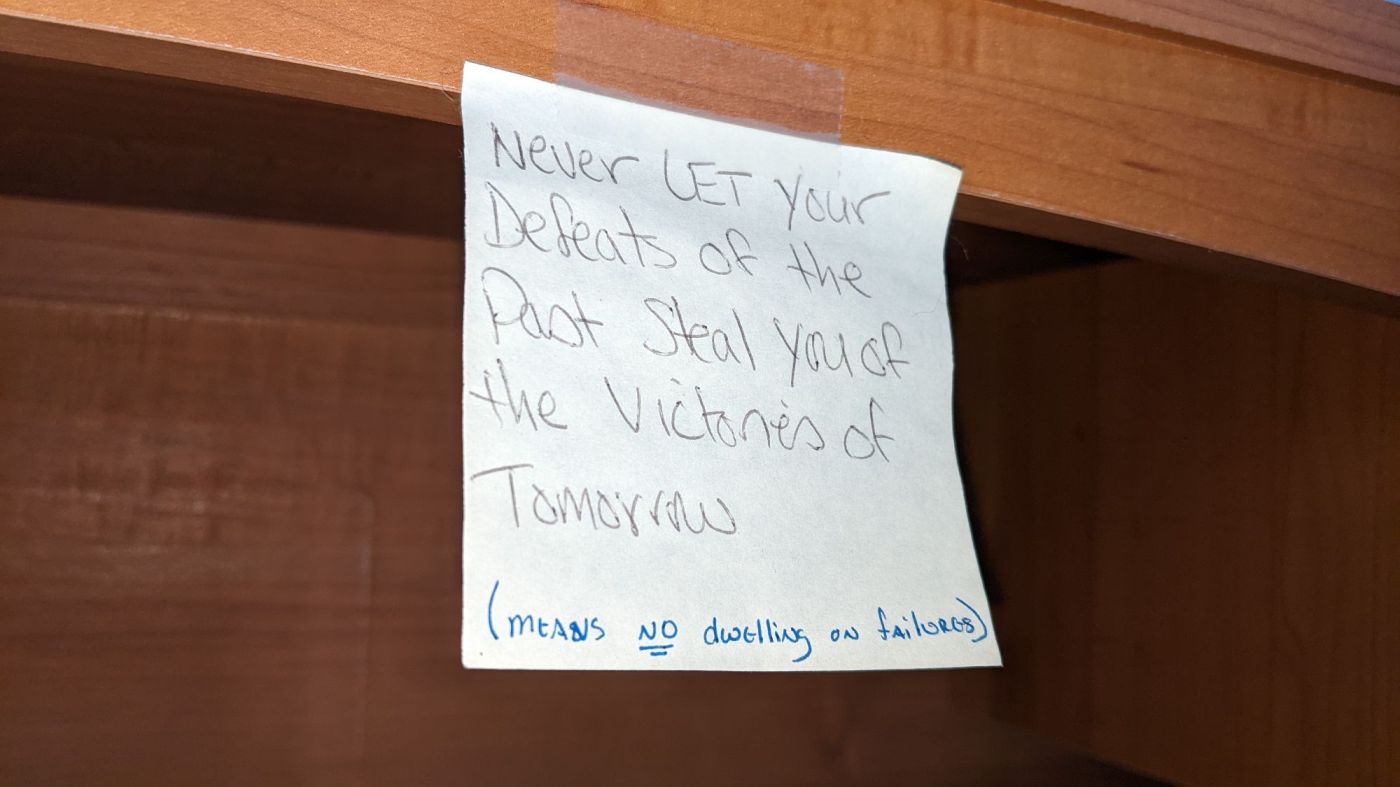
The sticky note pictured above hangs at eye-level over my computer desk that reads, “Never let your defeats of the past steal you of the victories of tomorrow.” Underneath it, my wife wrote, “mean’s no dwelling on failures!” I do that a lot. Reflecting on your approach does not mean dwelling on what you could have done, or shouldn’t have done. It means, getting better the next time around—barring the Holy Spirit’s will in how you shared Christ to begin with. You should always strive to share the gospel clearer, and bolder than before. Learn from the past remembering that no one is perfect.
As the gospels teach in the parable of the soil, some have stony hearts like concrete. You can give some Atheists all the proof to their satisfaction that God exists, but they would NEVER worship Him. There is nothing you can do in your approach to solve that conundrum. Yes, we rejoice when the seed of the gospel sprouts into a fruitful Christian, but we also should be happy when we have the opportunity to plant it. In doing so we worship the Lord through our obedience in fulfilling the Great Commission (Mark 16:15).
Evaluate Your Own Motivations
It’s good to stop and reassess your motives. Stop and ask yourself why you are really sharing the gospel to this particular person. What are your motives? Is it for a better marriage? Is it for a better relationship with this person? What benefits you if this person gets saved?
Juxtapose it with how would you feel if things never worked out the way you hoped and the person never becomes a follower of Christ? Would that shake your faith? Would it diminish the message at all? Would you quit while you were ahead? Would you even care?
If your heart is in the right place, even when things aren’t working out the way you hoped, your integrity and sincerity will be genuine. Share the gospel not so much that the other person will be saved from God’s eternal wrath, but that from the moment he or she is justified in His sight that their life will be fruitful to the Vinedresser (John 15:1-8) and glorify the Father.
Acceptance and Know When to Let Go
Accepting and letting go can mean several things to different people. Here’s what it doesn’t mean:
- Stop praying
- Give up and quit trying
- If they bring it up—dismiss it completely
- Divorce yourself from the other person
But it means after doing all you can, trusting that the seed of the gospel has been planted. Keep praying and hope for a time when they might be ready to listen. Knowing you cannot force change is freeing in a sense.
Who then is Paul, and who is Apollos, but ministers through whom you believed, as the Lord gave to each one? I planted, Apollos watered, but God gave the increase. So then neither he who plants is anything, nor he who waters, but God who gives the increase. Now he who plants and he who waters are one, and each one will receive his own reward according to his own labor.
1 Corinthians 3:5-8 NKJV
Jenni’s death rocked me. It didn’t just take my legs out from under me—it cut my legs off. I was absolutely paralyzed for two years after. The “what if’s” came to my brain like a flood. What if I got saved sooner, what if I said things differently, and the worst one—what if I said something that caused her to reject the gospel?
Even though I needed that time of grieving, I also had to get back up and keep going for those who are still with us, and so do you.
 Pens & Wrenches
I loved this!! Thank you so much for writing in a way I can understand!! Yahoo Mail: Search, Organize, Conquer
LikeLiked by 1 person
Thank you, Carol. I try to make it as simple as possible. Still trying to find my writing voice and style.
LikeLike
Your doing great!!
Yahoo Mail: Search, Organize, Conquer
LikeLike
Good post!
I’m sorry about your sister. 😞
LikeLiked by 1 person
Thank you, Cathy.
LikeLiked by 1 person