

One of the biggest hurdles Christians face when sharing the gospel is learning how to transition from an ordinary conversation into a spiritual one without making things awkward, uncomfortable, or forced. We don’t want to sound like a high-pressure salesman, but a caring friend who really just wants the best for those we converse with. We want to be listened to because we really believe that we have the words of eternal life.
But, how do we share such an important message of urgency without acting like their literal clock is ticking with a minute left? Honestly, this is difficult for me too. Probably my biggest personal challenge actually. I know I’m not a slick conversationalist, but I want to recognize the opportunities before me and engage the person with respect, honesty, and above all—humility and love.
A friend sent me this video about the interaction between pro basketball star, Sophie Cunningham, and Podcaster, Theo Von. It was an interesting exchange, and thought it deserved some credit talking about how not to be weird in conversations about Jesus.
“I Should Bring You to Church With Me.” (1:02:20)
It’s interesting how natural this is when Theo asks Sophie about her baptism and you can tell things started off a bit awkward. He’s getting fidgety in his seat, she’s looking at him with her head tilted. Then, she says, “I should bring you to church with me,” and instantly he rights up in his chair, leans forward, and gets into the conversation. His whole posture changes. Why? Well, for starters he is and has been interested in Christianity and has tons of questions of his own.
But she never questions him about how much he knows or understands. She just says, “I should bring you to church with me.” Basically, she changes what Jesus said 2,000 years ago—”Come and see,” (John 1:39). Philip copied this approach when he invited Nethanael (John 1:46). The outcast Samaritan woman whom Jesus spoke with at the well was given boldness and courage because she knew Jesus was the Christ and invited the men to come and see Him (John 4:28-30).
We must remember that we are introducing a dying world to the One and Only Christ who can save them. It was who He was that gave Philip and the Samaritan woman the courage to invite them to come see Him.
It’s an invitation; not a declaration.
“I Love Jesus and I Understand You’re Intrigued By It a Little Bit.” (1:02:52)
Sophie just comes out and says, “I love Jesus…” Basically just comes out with it. Why is that weird? When we love someone, we talk about them all the time. We want to get to know them, talk with them, hang out with them. We want others to know them too. So, why is that not weird when we are talking about flesh and blood human beings, but when we talk about Jesus it’s instantly nuts?
Fear is contagious, but so is boldness when done right.
Sophie then turns it to Theo Von and says what she knows about his situation and what she’s heard about the transformation in his heart towards Jesus. This is so cool because now she is giving him an open door for him to speak and be bold and talk about Jesus himself. She’s being intriguing to draw out more from him.
It’s a conversation; not an allocution1.
We’re Witnesses, Not Defendants (1:03:40)
Sophie Cunningham then shares how Jesus has transformed her life and all that He has done for her. She also explains how she responds to backlash and how Christ keeps her grounded in the unpredictable world of basketball, so she no longer worries about what people think of her, because she isn’t living for their praise.
This is important to note because Von is in the spotlight as a famous podcaster and how he may receive backlash for even considering being on team Jesus too. It doesn’t make us immune to what the world thinks of us, but makes us stronger in it. The world needs to see that having the Creator of the universe as the Holy Spirit residing in us is the best gift ever. We need to help the world crave Him.
Notice she’s not giving a bunch of facts about Christianity or knowledge about apologetics and how creation science is involved in proving God’s existence. She’s merely introducing Christ in a way you would a friend. And it’s clearly not what’s needed, or what Von is fishing for.
If I don’t share with others what Jesus has done in my life and what He can do in theirs, then why am I here? What is the purpose of our existence? I truly don’t need to prove that God exists. He is not the one on trial—the unbeliever is. My role is simply to tell my part of the story: what I have seen and what I have experienced.
We are witnesses, not defendants.
Stick to the Basics (1:06:30)
One thing I want to really start focusing on when sharing the gospel is to find out what the person needs in the moment, or at the very least find out what they think they need. We all know they need Jesus as their Lord and Savior, the covering of His blood for their propitiation to gain eternal life. They need the Holy Spirit as friend, helper, and seal of their salvation.
But they don’t know that.
The world have wants, desires, and needs of their own. But we have to realize where they are at first, and it takes that deeper conversation to get there. Some don’t know God exists. Some know He exists but He’s too busy to care. Most people—and it’s a stretch to say this—actually desire a connection with God, because they know in the deepest recesses of their heart and mind know it’s all true. But for whatever reasons they suppress the truth (Romans 1:18).
Instead of starting out telling a person what they know about Jesus, maybe start by asking what they already know. We need to know where they’re at. Leave the Christian lingo aside and give them the basics plain and simple. A brand new Christian doesn’t have it all together. Give them grace. But for an unbeliever they need to know they stand condemned and ask how they feel about it.
Show Them Christianity is Normal (1:17:28)
There’s nothing wrong with questioning and asking the “why” about God. Questioning is normal. The disciples of Jesus, God in the flesh, had so many questions. So many times they got it wrong. But asking honest questions shows you they care about what you are saying. Honest questions, not these gotcha, “stump-the-Christian” questions the pharisees asked Jesus to condemn Him.
On the same line of thought, Christians need to know:
- Talking about Jesus is normal.
- Worshiping God corporately is normal.
- Praying is normal.
- Bible study is normal.
- Sacrificial giving is normal.
- Loving people you don’t like is normal.
- Biblically standing up for justice and mercy is normal.
- Believing the Bible and science is compatible is normal.
- Sharing the gospel is normal.
If the typical lukewarm Christian does not recognize these things as normal, how can we possibly persuade a world rushing toward hell that they are? People influence one another, and it is evident that we are no longer functioning as salt and light. Why do I say this? Because it should not be considered normal for a Bible-believing Christian to think otherwise, yet most do. Most who profess to be Christians align more with the world than with God’s Word. Many Christians reading this will likely dismiss what Sophie is doing and saying in this video as extreme and fringe.
Did that sting? Good. It should.
End the Conversation With Some Solid Resources (1:18:30)
Sometime in the conversation if a person is desiring to know more but doesn’t know where to go, it’s good to point them in the direction of those who know more than us. For one: we can’t know it all, but collectively we can. And two: they need to know there are more of us who believe the same thing. There’s safety in numbers.
Tracts are good, but you need to give things that help them answer questions, not create new ones. They need solutions, people to talk to, places to go. Much of the time people don’t like to share their information with strangers, and that’s ok. But give them tools to further their walk on their own and connect them with people that can help. A website, a solid Bible believing and teaching church, a good book or video are good starts. Here are some of mine:
Got Questions Cards
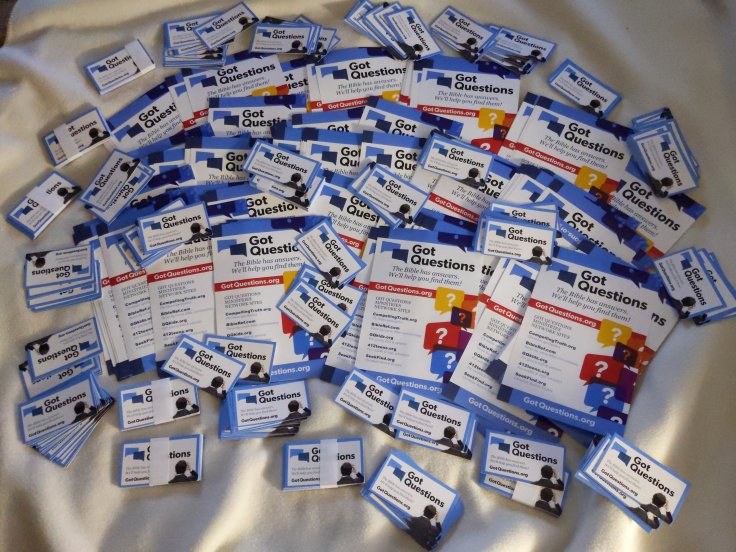
These are great tools that easily fit into a wallet or purse that connect people directly to the Got Questions Ministries on their own time. They can access the website to research info on their own, or fill out an online form to ask a specific question and get a human response in a few days.
It also links the ministry’s sister-sites:
- Bible Ref
- Compelling Truth
- 412 Teens
- GQ Kids
You can order these cards free of charge through their general information email at: questions@gotquestions.org.
The Gospel of Jesus Christ: An Introduction to the Good News by Paul Washer
I have heard many good things about this book, even though I do not own a copy or have read it. But, it would be worth considering as a main book resource to put in my backpack. Here’s how it is described:
You believe the gospel is true and powerful. Yet real evangelistic conversations are often brief, imperfect, and unfinished. Many Christians walk away wishing they had spoken more clearly, had more time, or had another opportunity to follow up.
The Gospel of Jesus Christ by Paul Washer exists to meet those moments with clarity and faithfulness.
This Scripture-saturated gospel booklet sets forth God’s holiness, humanity’s sin, Christ’s saving work, and the call to repentance and faith with seriousness and precision. It is written to be placed directly into the hands of unbelievers, allowing the truth of the gospel to continue speaking when your own words fall short or the moment passes.
Small in size at only 43 pages long, it’s not overwhelming for those who don’t read much. These can be ordered through Reformation Heritage Books. These books are expensive, but can be ordered cheaper bulk.
I’d also encourage them to take your information so you’re ready for any opportunity. You don’t really need theirs as much as they may need yours, and sharing it puts you in a great position. At the very least, they’ll have a way to reach you when something comes up. It’s always better to have it and be prepared than to miss out because you didn’t.
But, the Truth is…
Some of you may be wondering halfway through the article why I didn’t post the original episode from the Theo Von Podcast. Well, because things got pretty—weird.
And it wasn’t from the “Christian” in the room either.
Most of the questions Von asked were about lesbians in professional basketball. Seriously. I am not making this up, and it was frankly very disappointing. When you choose to swim upstream in a world where dead fish float past, you should be prepared for disappointment. Over the course of a three-hour conversation, the questions kept coming, and Von returned several times to the topic of lesbians hooking up in sports, which made Sophie increasingly uncomfortable.
The truth is that the world is not ashamed by the things they do and talk about that lead to destruction, openly celebrating choices, attitudes, and lifestyles that ignore consequences, hurt others, and ultimately pull them farther away from God, what is good, true, and life‑giving.
So why then are we sometimes ashamed and shrink back for the things of righteousness? Be bolder.
- usually means: Formal speech, especially by defendant. ↩︎


Leave a Reply