
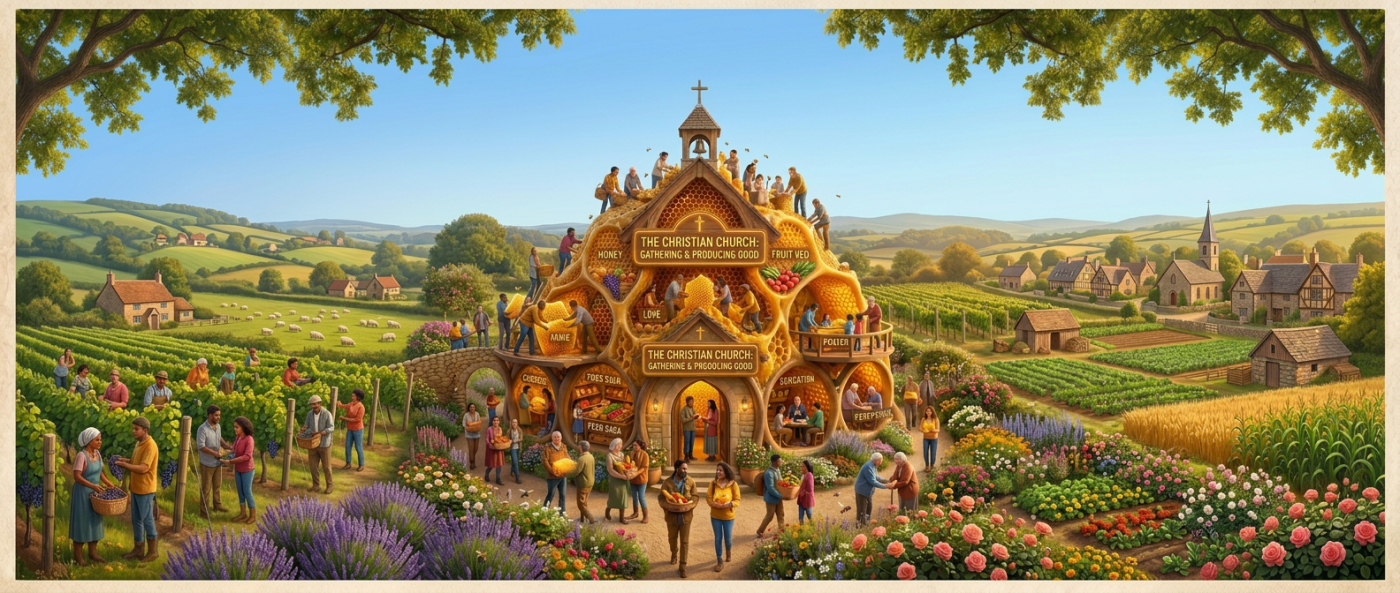
Throughout the Scriptures, the natural world serves as a living classroom where the Creator illustrates profound spiritual truths about human nature, our frailties, and out deep need for divine grace. Have you ever stopped to think about how God’s glorious creation is a picture of what he intended for us and His church and how we can use it to share the gospel of Jesus Christ to those around us? Throughout His Word, we find example after example of how our Creator wanted us to live by considering His lesser creatures and how they function and do their part when they do what they were created to do.
He tells us in Proverbs 6:6-11 to consider the ant which takes care of itself and others without having to be told by a captain, overseer, or ruler and an example to work and not be lazy—mere survival as our motivator.
In Luke 12:24, Jesus challenges His listeners to, “Consider the ravens: They do not sow or reap, they have no storeroom or barn; yet God feeds them. And how much more valuable you are than birds!” By this He exposes our anxious tendency to act as if our survival rests solely on our own shoulders.
Or in Luke 12:27 where Jesus tells us to consider even the simple wildflowers and how they don’t toil, labor, or spin, yet are arrayed in effortless beauty under God’s sustaining hand, confronting our anxious pride, revealing how often we seek security in our possessions rather than the Father’s care.
The apostle Paul understood this; creation’s staggering complexity and beauty leave humanity without excuse for suppressing the truth, reminding us that we did not arise from random chance or unguided processes, but were intentionally created to know and honor our Maker. (Romans 1:20).
Creation shows us our frailty. Our moral accountability. Our spiritual poverty. Our need for redemption.
Let’s dive in the hive as we examine one creature not mentioned in the Bible—the honeybee. What are the lessons it shows us? How we can use this little creature to show the world what the church was meant to bee (sic)?
A Life’s Work Honeybee Necklace

Last week I started working on my yearly Christmas article about gifts for men and women about unique gifts to use to share the gospel in unique ways. As I was doing research, my wife showed me this gem in the Uncommon Goods catalogue, I was immediately drawn to it. This item really captures God’s amazing creation and will for us so that when we work together as a church, we can do great things. From the catalog, it reads:
“A single drop can hold the story of a lifetime. Madeline Shir transforms that idea into something you can wear, encasing real honey, from her own bees, in glass as a tribute to the power of small, meaningful efforts. It is a precious and necessary contribution to a thriving community that works together to make incredible things possible. What may seem like just a drop becomes something larger—a reflection of care, connection, and the countless moments that build something lasting. Light catches the golden hue as it moves within the glass, a gentle reminder that every contribution matters.”
To think that this small vial is one bee’s contribution for an entire year of honey, when combined with other bees in a healthy hive, it can produce it can produce between 30-100 pounds of honey in one year. That is equivalent to between 3 and 9 gallons. That is incredible!
This really got me thinking about how a beehive is a close representation of how the church should be: when each person does his or her part in a healthy collective, amazing things can be achieved if we work together for a common goal.
The Church is Like a Beehive
The beehive is a beautiful picture of a healthy church; the key being that a hive produces far more together than any single bee could produce alone. In the same way, a healthy church is not built on a few people doing everything, but by every member faithfully contributing what God has given them. Here are some lessons we can learn from God’s amazing creation of the honeybee and its hive.
1. Small contributions make an extraordinary impact
If a single honeybee produces a tiny fraction of a teaspoon over it’s lifetime, thousands working together can achieve greater impact than by working alone. Therefore, no single bee can fill a jar of honey. But as each bee contributes a little, the colony produces something no individual could accomplish alone.
The same is true of the church.
- Some clean the church: vacuum and mop floors, clean bathrooms, tidy up, and clean windows.
- Another shares a talent or skill.
- Someone welcomes a visitor who feels alone or burdened.
- All give financially which can achieve big things together instead of on their own.
- Some pray faithfully.
- One creates slides for announcements, a website to share information, or meals to a family in need.
Individually, these acts seem small. Collectively, they build a church that is alive, caring, and fruitful. The church is not found in what one member can do, but in what all members do together (1 Corinthians 12:12-31).
2. Every member has something to contribute
A beehive works because the colony depends upon each bee doing their part. A church flourishes when its members understand that they are not merely attendees or consumers; they are participants in God’s work and a greater good.
We each have three important things we can offer:
- Time. Visiting the sick, teaching children, helping a neighbor, cleaning, welcoming people on Sunday. Ask yourself: Where can I make myself available?
- Talent. Through gifts that God has given, some teach, lead, organize, repair, listen, play instruments, sing, etc. Every gift can strengthen the church. Ask yourself: What has God equipped me to do?
- Treasure. Financial gifts, large or small, help provide for ministry, care for people in need, support the building, and create opportunities to share the gospel. Ask yourself: How can I faithfully share what God has entrusted to me?
1 Peter 4:10 says, “As each one has received a gift, minister it to one another, as good stewards of the manifold grace of God.
3. There’s so much more than just Sunday
One may think that the goal of a beehive is to produce honey. That may be one aspect of the collective, but that’s not the whole. From a biological and ecological perspective, the goal of a beehive is the survival, reproduction, and continuation of the colony as a single superorganism on the inside, while also pollenating, fertilizing plants, enabling growth and continuation of entire ecosystems. When hives suffer, the ecosystem suffers with it.
Likewise, a healthy church is not measured by it’s budget, attendance, or programs. As the point of my last article, The Cobra Effect: Lessons from Modern Church Growth, it is measured by the transformation of its members individually, while working together to inspire the world to walk with Jesus Christ.
We see this in the exemplary church of Thessalonica stated in First Thessalonians chapter 1 as they:
- praised for their work of faith, labor of love, and patient endurance (2).
- became imitators of their mentors and of the Lord (6).
- received the word in much affliction (6).
- received joy in the Holy Spirit (6).
- became examples to believers in Macedonia and Achaia (7).
- were evangelistic to the whole known world (8).
- were praised to Paul on how strong their faith in God was (2,8).
- repented and turned to God from idols (9).
- served the living and true God (9).
- waited patiently for the Lord’s return (10).
But how is this possible? Not by attending just once a week and hearing a 15 minute sermon. It’s by:
- Studying the Scriptures and being doers of the Word and not hearers only (Matthew 7:24-27; James 1:22-24)
- Being discipled to make disciples (Matthew 28:18-28; Ephesians 4:11-12).
- Being filled and equipped by the Holy Spirit and allowing Him to help you in all areas of ministry.
- Brotherly love for other Christians by helping them succeed individually and the church as a whole.
- Love and compassion for the lost which motivates our witness.
- Patiently enduring trials and suffering while allowing them to refine us in the crucible of God’s furnace.
But sticking with the theme of the article, none of these things cannot be done without…
4. Unity and the combined effort through individual input
On a personal level, I imagined what my home church of Calvary Chapel Des Moines could be like if we put this into practice.
We have roughly 100 people attending faithfully each week. Imagine if each person contributed just one hour a week to ministry outside Sunday mornings, that would be 100 hours of service every week or about 5,200 hours a year! Could you imagine what we could do for God’s kingdom as we worked together. Those hours could help feed families, visit the lonely, mentor children, care for older adults, repair homes, and my favorite—go into all the world and make disciples of all nations!
And that’s only time! That doesn’t include the value of each person’s talents, financial giving, prayers, relationships, and acts of kindness. If a church brought in $100,000 a year, that is only $1,000 per person.
What about increasing the church to create more disciples who make disciples? If each person in the congregation led just two people to the Lord which resulted in being discipled, that would be 300 people total attending, growing, and going out.
But what happens when only a few people are doing the work of the church? Ministry gets overwhelming and less hands make hard work, but also less ministry happens. Some say that the square root of your total members of the church are the ones who really are contributing. By that standard, it would be ten. In order for the same amount of work to be done, it would take:
520 hours a year / 10 hours a week in time
$10,000 a year / approx. $193 a week in treasure
Even if you could somehow find 10 people willing to “faithfully” share the gospel and disciple others, each of them would still have to convince 30 people to convert in just one year to get the same results. Given how often people consistently reject religious pitches, how many exhausting hours of trying—and failing—would that really take? When you look at it realistically, it would be an impossible feat that would no doubt burn out those ten. But, I know and you know that salvation is not of us, but of the power of God.
A healthy hive that produces much honey and cultivates the world around it to make a healthy world comes from healthy unified bees.
A spiritually healthy church that produces much for the kingdom of God and should change the world around it to advance the kingdom of God, comes from spiritually healthy unified Christians.
This past week, my pastor, Brent Fees, preached a sermon on discipleship from the perspective of unity. I encourage you to watch it, reflect on what it truly means to have unity in Christ as a disciple, and honestly consider whether you are living that out and how you might grow in it. The entire series is excellent and well worth your time.
Bee a Unified Disciple of Jesus Christ!
When you look at a jar of honey, you see something sweet. But you don’t see the thousands of tiny acts that made it possible. You don’t see every bee that flew from flower to flower, every trip it made, or every small contribution it brought back to the hive. No single bee makes a jar of honey. It takes a colony working together.
Church, we are like that hive. One person gives an hour. Another shares a skill. Another gives what they can. Another prays, encourages, teaches, visits, or serves quietly when no one is watching.
One contribution may not seem like much. But when each of us brings what God has entrusted to us, something beautiful happens. We become a church that can nourish the weary, care for the hurting, strengthen the faithful, and reach people we could never reach alone.
The question isn’t whether you can produce all the honey by yourself. You can’t, and neither can I. The question is whether each of us is willing to do our part. Because a healthy church isn’t built by a few people doing everything. It’s built when every member discovers that they have something to offer, and together we produce fruit that blesses the world.


Congratulations on a wonderfully insightful article. I especially appreciated your reminder that every member of the body has a role to play and that faithfulness in seemingly small tasks can have a much greater impact than we realize. The connection between the hive and the harvest was both creative and memorable, illustrating how individual contributions become part of something far larger than ourselves.
Thank you for sharing this perspective. It’s an encouraging reminder that no act of service is insignificant in God’s Kingdom and that each person brings unique value to the work He is accomplishing. Your message inspires both gratitude and renewed commitment to serve faithfully wherever God has placed us. Well done, and thank you for this thoughtful encouragement!
LikeLike