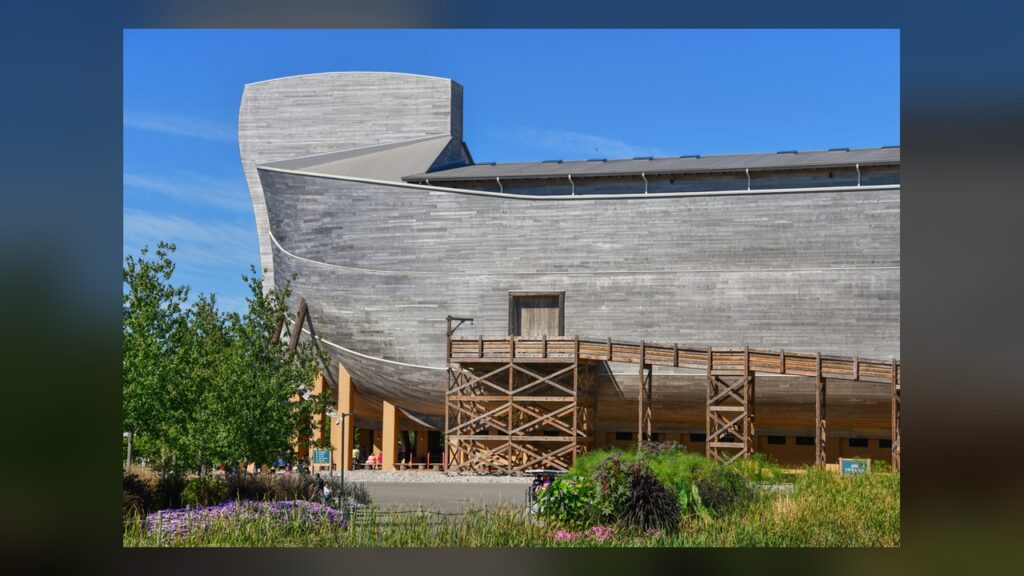
Within the past several months, a research project involving Sivas Cumhuriyet University and the organization Noah’s Ark Scans began a new geological investigation into the Durupinar formation in eastern Turkey: a large boat-shaped formation with the approximate dimensions of the biblical ark in Genesis 6:15 first identified by aerial photographs around Mt. Ararat in 1959. Using ground-penetrating radar, electrical resistivity tomography, LiDAR, geological sampling and core drilling, this team is trying to determine whether the structure is artificial or geological in nature.
While some researchers believe that the Durupinar formation is the Ark, many are skeptical. What we do know is that there has been no archeology that has been found to verify it is Noah’s Ark. With that being said, there are two pieces of equipment that will not be found and the Bible never mentions this sea vessel having: a steering wheel and a rudder.
Just Meant to Float
Nothing in the description of the Ark, nor God’s instructions to build it in Genesis 6 or 7 would constitute that it was designed to be steered by man or propelled in any way. We know this by not only what was written, and what was omitted. The Bible never mentions:
- A steering wheel
- A rudder
- A sail
Not only that, but the Bible states, as a window anyway, that there was one opening at the top of the Ark that allowed light and ventilation.
“You shall make a window for the ark, and you shall finish it to a cubit from above; and set the door of the ark in its side. You shall make it with lower, second, and third decks.
Genesis 6:16 NKJV
Some argue that it was a window that was one cubit high that covered the roof. Some also say that it is a one cubit opening at the top of the roof. We don’t really know what it was like, but further Scripture indicates it was a single window that could be covered and uncovered.
So it came to pass, at the end of forty days, that Noah opened the window of the ark which he had made.
Genesis 8:6 NKJV
Whether it was a single window or an opening encircling the entire boat, one cubit high, is of little consequence to me. My wife pointed out an intriguing possibility: if the window were at the center of the roof, it might have prevented Noah from really looking out. In that case, light would illuminate the entire boat, suggesting that all the cargo was positioned exclusively around the hull’s exterior, thereby creating an unobstructed path for light to penetrate to the bottom of the ship. This would also indicate Noah had absolutely no control of the ship or knowledge of what is happening on the outside; God alone had full control.
What Was Possibly Added
Though the Ark was only meant to float and not be propelled to go from one place to another, it was meant to survive possible high winds, waves, and prevent from capsizing. Most ancient ships of that period had what was called a stern post or bow fin: a rigid wooden structure that would catch wind and point the ship in the right direction into the waves, not along the waves. Answers in Genesis writes:
A bow fin would have served as an obstruction to the wind, pushing the bow away from the wind and into the waves, which would prevent the Ark from capsizing. In tandem with the bow fin, a “stern projection” would have reduced the swaying of the Ark’s stern, thus preventing the Ark from being pushed side-on by the wind. So these additional structures on the top of the Ark were designed to provide stability instead of giving Noah the ability to steer it through the waters.1
We can relate this to the Holy Spirit in our lives. In many places in the New Testament, the Holy Spirit is described as the Greek word, pneuma: breath, wind, or spirit. When trouble comes, which it always does, do we have the capability to catch the Holy Spirit, and allow Him to turn us safely through the brutal crushing waves, and not around them? For Jesus said in John 16:13, “When He, the Spirit of truth, has come, He will guide you into all truth…” That truth is not only found in the Holy Scriptures—it is the Holy Scriptures.
Are You Catching the Holy Spirit?
God does not promise that His children will bypass the hardships of this life; rather, He promises His abiding presence, comfort, and guidance to sustain believers directly through them. We see this throughout His Word.
We see in the same chapter of John that Jesus continues, “These things I have spoken to you, that in Me you may have peace. In the world you will have tribulation; but be of good cheer, I have overcome the world.”
In the Sermon on the Mount, Jesus describes a believer’s life in that the same storms that rage and come against the children of God are the same as those of the world. The only difference is how we react to them and allow the Holy Spirit to work in our lives through His Word if we hear them and obey them.
“Therefore whoever hears these sayings of Mine, and DOES THEM, I will liken him to a wise man who built his house on the rock: “and the rain descended, the floods came, and the winds blew and beat on that house; and it did not fall, for it was founded on the rock. But everyone who hears these sayings of Mine, and DOES NOT DO THEM, will be like a foolish man who built his house on the sand: “and the rain descended, the floods came, and the winds blew and beat on that house; and it fell. And great was its fall.”
Matthew 7:24-27 NKJV
The Bible explains that hardships, sickness, and grief exist because humanity lives in a world fractured by sin. Sin is rebellion against God’s holy justice, separating humanity from the Creator and introducing suffering and death into creation. Yet, in His immense love and mercy, God provided the ultimate rescue through Jesus Christ. By taking the punishment for sin upon Himself on the cross and rising again, Jesus offers complete grace and forgiveness to anyone who repents and trusts in Him.
For the believer, the third person of the Trinity—the Holy Spirit—indwells the heart as a Comforter, Counselor, and Guide (John 14:16–17, 16:13). The Holy Spirit provides supernatural peace and endurance during the fiercest trials. Though the storms of life are unavoidable, they are never outside God’s sovereign care or control. As in the Ark, God invites His people to find refuge in Him as they walk through its only door — Jesus, strengthening them through prayer, His Word, and the presence of His Spirit.
Because the Lord is with His people through every wave and surge of life, the believer can rest in the truth of “God is our refuge and strength, an ever-present help in trouble.” (Psalm 46:1, NIV). We walk through the valley of the shadow of death and He prepares a table before us in the presence of our enemies (Psalm 23:4, 5). Even when the storm does not immediately calm, the Holy Spirit provides the peace, wisdom, and strength needed to navigate safely through to the other side because He is forever with the follower of Christ.


Noah’s ark is a rebuke to every part of us that still believes we must control the outcomes of our obedience. God gave him no rudder, no sail, no wheel—because the Kingdom is built on dependence, not direction. The ark floated because God carried it. Noah survived because God sustained him. And the same is true for us.
The Kingdom frees us from the crushing burden of trying to manage what only God can move. We are not asked to chart the waters, predict the storms, or engineer the rescue. You are asked to build what He commands, enter what He provides, and trust the Spirit who turns us toward truth like a bow fin catching the wind.
Our life may feel like an ark right now—sealed in, surrounded by waves, unable to see what’s ahead. But that is exactly where Kingdom faith grows. The King is not waiting for us to steer; He is inviting us to rest in His sovereignty. The Spirit is already guiding us through the waves we cannot avoid and the winds we cannot read.
Take heart. In the Kingdom, floating is not failure—it is obedience. And the God who carried Noah carries us with the same strength, the same intention, and the same unfailing promise.
LikeLiked by 1 person