
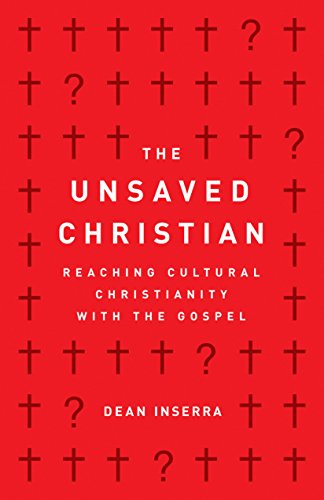
For the past year I have been brainstorming ways to share the gospel in my hometown to men who think they have everything, but in reality they are bankrupt. One would say to himself, I have a nice house, great job, good kids, a fast car and a hot wife. Why do I need Jesus? I know and you know that it’s less about this life, and more about the next when we leave these material things behind. But, thankfully, God’s kingdom is closer than we think. We learn about Him, grow in our walk, become mature, and share the gospel: the good news that opened our eyes, and give it to the world. After reading both covers, I knew this book was the missing key I have been patiently waiting for, and began to unlock it’s treasures. But after reading this book, I discovered the man I was really searching for was one who thinks he’s a Christian but lacks transformation which only comes through the Holy Spirit.
Reaching Cultural Christianity with the Gospel
This is the subtitle of the book that hit my curiosity, which really sums up the entire book in a nutshell. The best way I can describe: it’s a field manual for sharing the gospel to the person who genuinely believes he is a Christian without any fruit or evidence to show for it. In other words — “Bible-belt Christians.”
Cultural Christianity is not Biblical Christianity at all, but a cheap pseudo-religion that offers:
- Christianity without the cross
- A “belief” in a generic deity without sacrifice
- Moral values without accountability
- Admiration of Jesus without submitting to Him
- A vague spirituality without repentance, faith, or new birth.
- Religious rituals without saving faith
- A form of godliness without the transforming power of the Holy Spirit.
- A false assurance of salvation without the evidence of a changed life.
In essence, Cultural Christianity is a social label or heritage rather than a transformative, personal relationship with Jesus Christ. They want enough Jesus to be respectable or get into heaven, but not enough to carry a cross or allow Him to change their plans on earth to serve Him wholeheartedly.
How Did We Get Here?
According to the book, the primary cause of cultural Christianity—aside from human sin—is a widespread confusion over what the gospel actually is and is not. This confusion has been fueled by several societal, theological, and institutional factors; some of which are:
- Heritage and social identity: For many, the label “Christian” is a family heritage rather than a personal faith.
- Morals over Holiness: God is a “cosmic therapist” or “divine butler” to help people rather than serving Him as Lord of all.
- The “Good Person” code of ethics: Rather than seeing ourselves as sinners in need of saving, we see ourselves as a good person because rely on external religious actions like going to church on Christmas and Easter.
- Loss of biblical authority: They believe the Bible is no longer viewed as authoritative and have replaced it with traditions and progressive ideas of society.
- Fear of offending in the church: Some churches have contributed to the problem by focusing on “inspiring” messages while avoiding challenging topics like sin, repentance, holiness, or the blood of Christ in fear that people will leave the congregation.
This discussion certainly encompasses several critical factors not fully addressed in the book, such as the impact of modernism and post-modernism, which challenge traditional forms in the pursuit of experimental truth. Additionally, the tension between emotionalism and objective truth, along with the emergence of liberalism and social justice, plays a crucial role in the formation of cultural Christianity.
Useful Chart
One of my favorite and useful tools is a chart in the back of the book that sums up all the cultural Christianity types, their profiles, how they mistake the true gospel for, gospel conversation starting points, and the remedies and challenges the budding evangelist will face or use during the conversations. This includes Scriptures to use and how to approach the conversation in a meaningful way.
I love when authors do this especially when it comes to field manuals like this. You want a great resource to go to in the moment with key points but don’t have the time to search. This doesn’t take away from the book, but I feel charts like this whet the appetite to read more. And this chart certainly does.
How to Get the Most Out of the Book
In order to get the most out of the book, I suggest the following things to keep in mind.
Read and answer the questions
In the back of each chapter there are questions for discussion and reflection. This may not be imperative for the seasoned evangelist because he or she already thinks about these things on a daily basis, but those who are inexperienced will find them very helpful.
Many questions made me think and take notice things in myself that I need to change. One of the most impactful ones was asking if there were anyone I gave a pass to because they are, by the world’s standard, a good person. And there were. I just never really saw it that way. The truth is, those people can be the “most lost” because they have no reason to change. And those were mostly the ones I primarily wanted to reach in Ankeny, Iowa.
Don’t pass over “Remind Yourself”
At the end of the “Questions for Discussion and Reflection” is a subtle paragraph called: Remind Yourself. This is a short paragraph of verses, hints, and tips when discussing the topic of the chapter with your “unsaved Christian.” I suggest you look up the Scripture references and write them down somewhere where they can be easily accessible. Maybe your evangelism sword (Bible) you take on the streets. Because honestly, it’s the Word of God that will transform hearts and minds to seek and serve Him.
The “Tripple Threat”
Another thing to do is incorporate this book with other outside resources to increase it’s potency and get the “unsaved Christian” to think about themselves.
For starters I would incorporate it with asking “Tactics in Defending the Faith” questions:
- “What do you mean by that?”
- “How did you come to that conclusion?”
- “Have you considered ______?”
Another resource I would pair this with is sharing the law before grace tactics of Ray Comfort of Living Waters. The main reason why these people have become “unsaved Christians” is because they were never taught the true gospel found in the Bible. Many of these people were never confronted with their own sin and how it is enmity with God’s holiness. Therefore, it we don’t see our sin as exceedingly wicked and how it effects our relationship with a holy God, we will never see the need to beg for mercy at the cross to receive righteousness and redemption which only Christ can provide through His death, burial, resurrection, and sealed by the Holy Spirit.
Using the information from “The Unsaved Christian” book, along with “Tactics in Defending the Faith,” and law before Grace from Living Waters is the “tripple-threat” of gospel proclamation whether it’s to family members or on the street with strangers.
Who Can Benefit from Reading This Book?
This book is geared towards many different types of people, none of which are isolated from each other.
This book is written with the evangelist, the church leader, or ministry worker in mind. He teaches them how to identify and fully understand the different types of cultural Christians, offers appropriate starting points to engage them in deeper conversation, and how to preach the real gospel to the cultural Christians in your life.
But, this book can also help those who are in mainline protestant, catholic, and social justice Christians. If used correctly and given by someone they respect, this book can offer a “wake-up-call” as they look at it as a mirror and think about their own life. But, they might not read or stop reading because it will make them uncomfortable.
If you are in a good, solid church that knows and teaches the gospel, I suggest getting the book and training leadership using it to spot these various cultural Christian groups and how to engage them in conversation. Also, having a book study within the church would be beneficial; not only training people how to interact with those of this mindset, but also to look in the mirror to see if they personally follow the trend.
Final Thoughts
The title of this book might be misleading, and the author is not claiming that some Christians could be unsaved. He clarifies this multiple times in the book. The main aim is to encourage readers to pick it up, read it, and reflect on their own hearts and those of their loved ones.
I was also taken back with the mention of reaching “generational Catholics” instead of Catholics in general, but Dean Inserra never implies that Roman Catholics are saved. Like many do, he says it doesn’t mean that no one in the Catholic Church is a Christian. But it begs the question—why stay? It bothers me, as a former Catholic, that many protestants believe Roman Catholics are saved, not knowing many of the anti-biblical traditions they follow. My view has always been this: if the individual Roman Catholic comes to the truth and gets saved, he or she will run from their old doctrine surrounding Mary and the Pope, and embrace Jesus Christ and His Word. But, Dean Inserra does a good job of explaining that justification by faith which is a necessity to the Christian faith is anathema to Roman Catholic doctrine, and are not the same concerning some significant core beliefs.
I really loved the book and I could not put it down. Highlighting a ton of sentences and paragraphs along with taking notes where there was space, I found myself going deeper into its pages. I would even consider having a book study and teaching through this to equip Christians to engage their false assured friends and family. It will definitely help me to share the gospel to those in my hometown. But one thing is for sure, this book will never leave my library. 5 stars all the way!
 Pens & Wrenches
What struck me reading your review is how accurately you name the real challenge: not hostile unbelief, but the quiet, confident assumption of salvation without any evidence of new birth. Cultural Christianity is comfortable, familiar, and socially rewarded — which is precisely why it’s so spiritually dangerous. Your summary makes clear that Inserra isn’t trying to be clever or edgy; he’s trying to wake people up to the difference between heritage and conversion, between morality and regeneration, between admiring Jesus and submitting to Him as Lord.
I appreciate how you highlight the chart in the back of the book. Tools like that matter because they help us move from vague concern to intentional, Spirit‑led conversations. And your point about the “good person” being the most resistant is painfully true — those who see no need for rescue rarely seek a Rescuer.
Your reflections on Catholicism and justification also add needed clarity. If someone truly embraces salvation by grace through faith, they won’t cling to doctrines that deny it. Transformation always leads people toward truth, not away from it.
Thank you for this review. It’s thorough, pastoral, and practical — and it carries the urgency this topic deserves. Books like this don’t just inform us; they sharpen us for the work of reaching people who don’t know they’re lost. May the Lord use it powerfully in your hometown and beyond.
LikeLiked by 1 person