
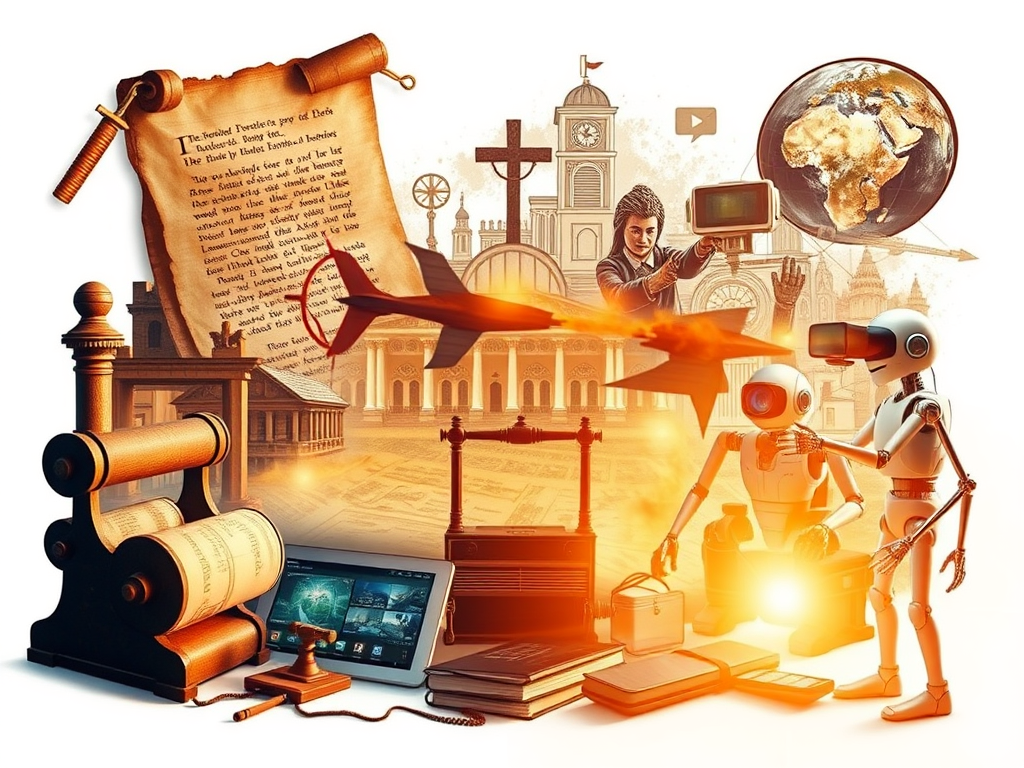
Throughout history, humanity has experienced a series of profound paradigm shifts, each reshaping how we understand and interact with the world. From the dawn of oral traditions to the advent of written language, the invention of the printing press, and the rise of digital technologies, each shift has marked a pivotal moment in the way knowledge is produced, disseminated, and consumed. Today, we find ourselves at the cusp of yet another transformation, driven by the digital revolution and the rapid integration of artificial intelligence, data analytics, and connected technologies. Understanding these shifts not only highlights the technological advancements that have defined our past but also sheds light on the increasingly complex and interconnected world we navigate today.
Paradigm Shifts in Evangelism Throughout the Centuries
But how have these paradigm shifts affected evangelism efforts throughout history? Throughout various epochs, shifts in cultural, social, and technological landscapes have significantly shaped how evangelism is conducted, influencing both methods and messages. The advent of the printing press, for example, allowed for the rapid dissemination of religious texts, making scripture accessible to a wider audience and sparking the Reformation. In more recent times, the rise of the internet and social media has transformed how religious groups reach out to individuals, enabling a more personal connection and fostering community in virtual spaces. Let’s try to shed some light on the subject and what we may see in the future, as we explore the ongoing evolution of evangelistic practices and anticipate how emerging technologies and societal changes will continue to redefine the landscape of faith-sharing.
The print age
Prior to the print age, books and documents were handwritten by scribes on materials such as parchment, vellum, or papyrus. This era began with civilizations like the Greeks, Romans, Egyptians, as well as Hebrews and continued through the Middle Ages of Europe. This culture was dominated by religious texts and classical works that were preserved in monasteries and other world-famous libraries such as the one in Alexandria, Egypt (Acts 18:24-25). This was not only time consuming, but expensive and only for higher classes of people. Literacy was limited to those who were rich and educated.
With the advent of the printing press created by Johannes Gutenberg in the mid-1400’s, the print age allowed for the mass production of books and opened up doors for the lower classes making books more accessible, cheaper, and widespread. It was in this process that gave the common man the ability to read Holy Scripture for himself directly and not spoon-fed from the clergy.
Modernism – the age of radio (1900-1945)
The print age gave us a standard to writing, science, and art and set the tone to social order and how humans communicated with each other. With the advent of Modernism though, it sought to change traditionalist views and create new ones. It focused on experimentation, abstraction, and subjective experience. It centered on the individual who was the key to social progress and contributed to individualism and reletivism. This gave way to new forms of writing, art, and style. It also propelled scientists to create inventions to make a better world, and not be afraid to fail.
At the end of the 19th century, scientists like James Clerk Maxwell and Heinrich Rudolf Hertz were experimenting with electromagnetic waves and sending these waves through free space which gave us the ability to transmit invisible radio waves through the air. By using this newly discovered theories, Italian Inventor, Guglielmo Marconi’s was able to create the Hertzian (radio) transmitter and receiver in 1894 by creating the first transatlantic radio which gave countries instant communication capabilities. In 1904, he established a commercial service to transmit nightly news summaries to subscribing ships, which could incorporate them into their on-board newspapers. A regular transatlantic radio-telegraph service was finally begun on October 17, 1907. This was revolutionary, and thus the modern age began.
Soon, countries and inventors were racing to create technology that could harness the airwaves for many applications to send and receive daily news, entertainment, military capabilities, and connect people in real time all over the globe. Around 1920, radio broadcasting was gaining traction which brought news and culture to homes throughout the United States and world. Ideas traveled at the speed of sound, and through commercials, radio programming, and propaganda, people were influenced faster than ever before.
Churches, evangelists, and other ministries used this new technology to spread the gospel faster than ever before, along with sending the message of Jesus Christ to all nation’s trans continentally. Though missionaries were still used and needed, the gospel had a further reach and capability to be in every home on the planet.
Many ministries used this new technology and incorporated it into their evangelism efforts. For instance, men like Billy Graham along with his partners, Fred Dienert and Walter Bennett, launched the radio program, “The Hour of Decision.” Instead of preaching to small revival groups in person, he reached millions every time his program was aired. His popularity exploded and it was radio that gave him the ability to reach world leaders.
But unfortunately, like printed material, radio also brought a plethora of false teaching, extra-biblical, and heretical views through the airwaves as well. Men like Herbert W. Armstrong, and his son: Garner Ted Armstrong, used the airwaves in both radio and television to preach against the Holy Trinity and promote Sabbatarianism to the masses. It goes to show how Lucifer was always the “Prince of the power of the air.” (Ephesians 2:2)
Postmodernism – the age of television (1946-2000)
Postmodernism is the rejection of modernistic naratives and strived to deconstruct its beliefs to create a more complex and diverse culture. It rejected the idea of a single, objective truth and emphasized a more subjective experience and individualistic interpretation. In postmodern art for instance, postmodernism rejected the single interpretation from the artist and creator, but opened itself to interpretations of the beholder, thus was not rooted in fact—but feeling.
Therefore, spiritual beliefs became subjective and emphasized pluralism and diversity as equally valid to factual objective truth. Phrases like, “I think,” or “I feel,” became the new truths, which blured fact and opinion so bad, none could tell them apart. This opened the door to a plethora of false teaching and beliefs that were not based on Holy Scripture, but feeling and experience. The Bible was introduced into mainstream television through talk shows, prosperity preachers and televangelists—which made words like “evangelism” and “evangelist” dirty words, even in the church. Soon the Bible was mocked and ridiculed on a wider scale and seen as rigid, and bigoted. One might concur that more damage was done than good.
Metamodernism – the age of the internet (2001 – 2024)
Metamodernism critiques modernism and postmodernism of the past, but at the same time tries to take the best of these and reintroduces them to achieve genuine societal transformation. The meta, in metamodernism, comes from the Greek word, Metaxis, used by Plato and Plotinus to explain the sense of in-betweeness, but not necessarily a middle-ground. Information was being produced at a rapid pace, and not all of it was persuaded as fact. YouTube, social media, podcasts and blogs turned the average every-day person into an “expert”, when they are not. Take the blog post you are reading right now; am I an expert in psychology or sociology? No, but I have only opinions and offer some insight into my thoughts. I could be totally full of “you know what.” Take YouTube for instance: everyone can literally have their own television program or talk show. Wikipedia, which is a web-based encyclopedia that anyone can edit, was launched in 2001. It became popular because it featured:
- Open editing: Most pages can be edited by anyone with internet access.
- Neutral point of view: Content is expected to be written without bias.
- Citations: Information must be verifiable and backed by “reliable resources.”
- Multilingual: Available in over 300 languages, because why should we just destroy English -speaking society. [emphasis mine]
My point being is that information even though accessed quickly is not always factual, and the lines between fact, fiction, and opinion are extrememly blurred. What was supposed to be an inbetween of intellectual brilliance turned into the greatest nightmare the world has ever known. But it gets worse, and it has failed.
What Now? (2025 – ?)
Now, I firmly believe we are in the beginning of a new paradigm shift which I call Post-Metamodernism—the age of A.I., and what you read from here on out is my personal thoughts on the matter as I look to the future and see we are headed for destruction if we don’t do something quickly.
What we have found out through Metamodernism is that quick and easy is not always good. But, that’s because we left it to humans to do the work. Humans are in a sense flawed creatures, and AI is the supreme being that knows best because sinners and broken humans are not at the helm.
Post-Metamodernism Evangelism
What does (being that we are in it now) evangelism look like in an AI age? What are the implications of this, and what are the good that can arise from it? Here are a few thoughts.
AI-enhanced personalizaiton
There are many different ways to start a conversation, but wouldn’t it be great to tailor those conversations to the specifc interests and background of the person you are talking to? Imagine using AI to generate a question or answer based on the beliefs, interests, and what drives or moves them?
Not only that, but churches could utilize chatbots with theological and apologetic content to engage seekers 24/7 in non-threatening, curious conversations. Instead of a pastor or evangelist being awoke at 2 in the morning with a phone call about faith and the gospel, the inquirer can just ask a chatbot and get an answer within seconds.
Content creation
Churches, missionaries, and evangelists can create gospel content, sermons, devotionals, at the click of a button in any language at any time. Not only this, but create media like pictures, diagrams, videos, animations, and music to share Christ and reach audiences that were unreachable before.
Data-supported outreach
What are the needs and desires of the people living near and around your church? What are they like, what do they buy, what do they think about or how do they spend their time? Why go out door to door and talk to them when you can get an outreach plan taylored to the people you want to reach? Nothing is more uncomfortable than going door-to-door; but what is even creapier is to see what people are looking at over the internet or buying online and using that to share the gospel.
Meta-church
The use of Virtual Reality (VR) headsets have exploded recently and with the formation of the Metaverse, there is no limit to what they could do. Evangelism and discipleship could take place in digital worlds where people could “gather” for worship, small groups, and have gospel conversations where they would never step into a physical church or leave their mom’s basement.
This is not limited to actual conversations; it is also a powerful resource for VR-style training tools, effective discipleship, coaching, and dynamic role-playing scenarios in vividly imagined lifelike environments. Sit in a bar and discuss theology with the bartender, then jump aboard a cruise ship and talk with a person you just met at dinner without paying the price of an all-inclusive jaunt across the sea.
Global mission
Reaching people in other countries or the unreached in other parts of the world can be done more easily with AI translating Scripture quicker and easier and helping to take the gospel where human missionaries can’t go. While translating the Bible or the gospel in other languages would be nice, it’s far-fetched to think that indigionous people in underdeveloped countries who don’t have internet access would receive any benefit to AI. Besides, countries like North Korea have digital information filtered and terminated at the ISP level. I guess they have to continue to resort to sending Bibles over the boarder by balloons for now.
Ethical, Theological, and Moral Challenges Ahead
Yes, although AI can pump out books on topics quickly and easily, write stories, and create art, we as human beings limit our ability to think and reason. Discernment and authenticity are out the window. We have hit the point where we are not creating as our Creator in His image, but we are just absorbing information. Everything will be done for us, and we will rely heavily on AI more than ever before. Why waste time searching for something when it can be handed to you on a silver platter? Like the movie WALL-E, humans will be fed, fat, and unhealthy physically, emotionally, and spiritually.
“For God is not unjust to forget your work and labor of love which you have shown toward His name, in that you have ministered to the saints, and do minister. And we desire that each one of you show the same diligence to the full assurance of hope until the end, that you do not become sluggish, but imitate those who through faith and patience inherit the promises.”
Hebrews 6:10-12 NKJV
Can AI truly witness if it lacks a soul or could never experience grace, forgiveness, and mercy? Can AI actally give Biblical advice to a person who is having severe marital issues at two o’clock in the morning? Can AI put it’s arms around a person wanting to end their life? Can it give sound Biblical advice to someone challenged with making tough life-altering discisions and cry with them knowing they’ve failed so far? Can AI hold a person’s hand and pray for those in the throes of drug and alcohol addiction? Will paid pastors of flesh and blood be replaced by AI generated bots that look real, handsome, and trendy on screen, but devoid of human empathy and compassionless? This final “-ism” could usher in the “image of the beast” (Revelation 13)—a robot with an AI super-computer / internet driven brain tasked with solving all the worlds problems and create a peaceful society for mankind, because frankly humans have botched it until now; and there will be no going back.
To hinder this from happening, we must take great care in reaching the lost and empowering Christ’s church with authenticity, empathy, discernment, and using the Bible as the standard of moral clarity. The true church will grow the more authentic we become, and those who rely on impersonal means of quick fixes will ultimately die. The Holy Spirit didn’t give us His gifts to empower His church for us to forsake them in ministry. Let’s abandon the quick-and-easy, and let us do the work God gave us to do—with courage, tenacity, humility, and love the way Jesus did.
 Pens & Wrenches
Some great thoughts on the use of AI. Thanks.
LikeLiked by 1 person