
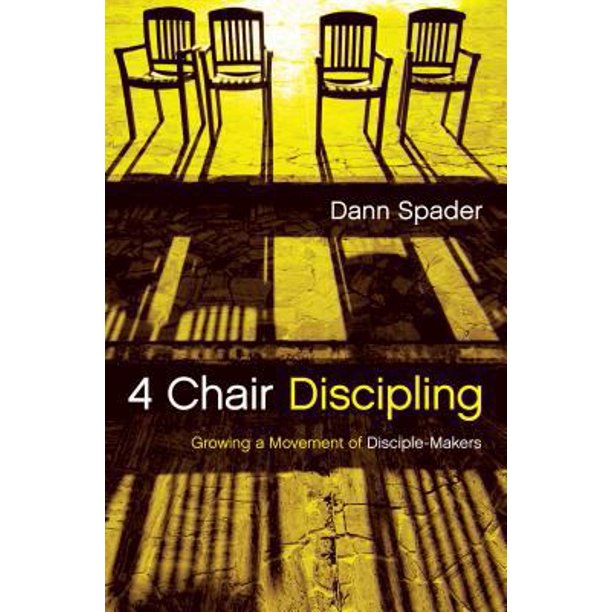
I recently read the book, 4 Chair Discipling: Growing a Movement of Disciple-Makers, by Dann Spader.
It was a refreshing read. Even though this book was only 154 pages long, which included the notes and appendix, it was packed with so much useful knowledge for the new convert to the seasoned pastor. It was very easy to read and follow, systematically moving the reader to the purpose of the book for a desired outcome. No matter what part of life you are in, there was something in it for you — and that was the purpose of the book.
Deep dive into discipleship
Jesus recognized that the people He encountered were at different stages of growth and development and worked to challenge each of them to move to the next level. The levels of development take the form of chairs individuals momentarily sit in:
- Chair 1: Come and See (John 1:39). The unbeliever
- Chair 2: Follow Me (John 1:43). The child Christian
- Chair 3: Become a Fisher of Men (Matthew 4:19). The young men/women
- Chair 4: Go and Bear Fruit (John 15:16). The parent
Within each chair there are things that individuals do, what their roles are, and the skills needed with each individual chair. This is very well laid out in the book, which even comes with a graphic overview of each chair in Appendix Three, so those reading can visually see what they need to work on and advance to the next chair. And that is the purpose of the book, to keep advancing to the fourth chair.
Part of a series of three
Even though I read the first version of this book, published in 2014, there is a second version published in 2019 which is part of the “Like Jesus” series by the same author.
- Walk Like Jesus: Who He Calls Us to Be. Jesus’ life was just as important as His death and resurrection.
- Live Like Jesus: How He Calls Us to Make Disciples. How to make the Great Commission a way of life the way Jesus did.
- 4 Chair Discipling: What Jesus Calls Us to Do. Jesus recognized that the people He encountered were at different stages of growth and development and worked to challenge each of them to move to the next level.
To be honest, I can’t imagine having to expound on what was already covered in the original “4 Chair Discipling,” but looking at the synopsis of each book in the Like Jesus series, I would be curious enough to take a look. Each book takes an even deeper dive into the “how” of discipling looking through the eyes of Jesus and what is told to us through the Bible about His daily life:
- His intentionality in fostering loving relationships
- His unwavering obedience and reverent submission to God
- A life that was steadfast in prayer
- His dependence upon the Holy Spirit
- His movement of multiplying disciples
- How Jesus made the Great Commission a way of consistent daily life
Like an appetizer at dinner, “4 Chair Discipling” wet my appetite for more, even though it was in and of itself a full meal. With 4.7 stars total on Amazon, I can see why 82% were individual 5 stars. This is one book you will want to keep around for good reference and to stay on track as you work towards the goal of the next chair.
And that is the purpose of the book, to keep on advancing to sit in the fourth chair and become a disciple-maker. Evangelizing and sharing our faith is not just going out into all the world and preaching the gospel so that people will become saved and sit around waiting to die so they can go to heaven. It is about disciples making disciples to make other disciples. It is about bearing much fruit for the kingdom of God, that while a person is living and breathing, he or she is active in growing God’s Kingdom here on earth. It’s not just winning souls, but transforming them through the power of the Holy Spirit to go out and win more so they will do the same.
If you desire articles like this sent to your inbox without missing a beat, consider subscribing below.


Thanks for the review. I am working on a book on discipling myself so this will be very helpful.
Shalom!
LikeLiked by 1 person
Shalom. My men’s group at church starts a different discipleship book for a 12 week study called REAL-LIFE DISCIPLESHIP. We’ll see how it stacks up to Dann Spader’s.
LikeLike
Can you explain why the author chose to use chairs as the foundation of his thesis? I have read several reviews of this book and my kids’ youth pastor just went over the four chairs idea in youth group with them, and we are completely confused as to why the author chose chairs. From what we understand, it appears that chairs are completely arbitrary and that they have absolutely no correspondence to the idea of growing in the faith to become disciple makers. It makes me wonder why the other chose such an example. Why not just call them the four STAGES that you move through? Or perhaps STEPS moving upward? Or LEVELS on a pyramid? Or take a biblical theme like a plant starting as a seed and moving toward flowering and bearing seeds? Why in the world CHAIRS?! In what sense do people normally move from chair to chair? They simply don’t (except in the game musical chairs). In what sense is the journey of sanctification and growing up to become disciple makers ever like sitting down in a chair? It’s not! It’s just truly driving me nuts that I cannot find a single reference or mention as to why the analogy is CHAIRS.
Additionally, my kids were astute enough to realize that these stages (ahem, chairs) are not so neat and tidy as is presented. When they were asked by their youth pastor which chair they would put themselves in, they opted to pick in between two levels. But they intuitively realized it’s even more complex than that. Take for instance, my dad. He shares the gospel every where he goes. He has a knack for working it into conversations with strangers and he plants those seeds everywhere. Yet, he does not faithfully read or study his Bible and never has. In fact, he never matured a whole lot in biblical knowledge, yet his faith in God is quite strong. He also has not ever served in any capacity in church (like Sunday school teacher, usher, nothing) – he just comes and visits with people, but he’s also the first person to lend a hand when people need help in the church. Then there is my mom who has always been dedicated to studying God’s Word – marking up her Bible and attending countless Bible studies. Her knowledge of doctrine far exceeds my dad’s. She also has served in various ministries at church over the years, from children’s ministry to crisis pregnancy center rep for their church to greeter. But I don’t think she’s shared the gospel (outside a formal ministry setting) in decades. Also she loves the Lord, yet she struggles with besetting sins that has caused some of my adult siblings to view her as a hypocrite due to her devotion to Bible study and church while at the same time not being able to overcome certain sins. Where would my parents fit in these chairs? They don’t perfectly fit in them at all. And I surmise that many Christians do not. In fact, my kids said that an elder who often attends youth group said as much himself when asked what chair he saw himself as – he replied that he though he had a foot in chair 2, 3, and 4. And from everything we can tell, he is dedicated to the Lord and His Word and bears much fruit.
I guess I’m failing to see why this book is so popular when the general concepts (growing up in the faith to become disciple makers, etc) should be known to every Christian just from reading Scripture and I just don’t understand at all this obsession with chairs that, to me, doesn’t seem to contribute to the discussion at all. In fact, there is a such a lack of correspondence to the topic that I don’t even think it would classify as an analogy. But perhaps I’m missing something having not read the book myself.
LikeLike
Sara,
Thank you for your input. Greatly appreciated and wanted.
I purchased the book at a local Bible College used bookstore and wanting to do discipleship better, I was a little curious. I had no idea this book was even popular since I never heard of the author. It was a cheap hardcover book that I thought would give it a spin.
So, why chairs? I don’t think he had a specific reason for chairs. As far as I remember and looking though the book he doesn’t give one. In watching some videos he mentions he uses chairs specifically because they offer a very relatatable metaphor about how we should disciple one another. Depending on the chair and how they are aranged can speak of different things. Some chairs are cushy and made to relax in while others are rigid and made to sit you upright and be at attention to learn. The way they are placed also suggests being alone, having a conversation with another person, or at a table with a group of people. Not that the following is his answer, but why it makes more sense to me after reading the book is that when we are being discipled by someone, we are in that place for a time. We don’t go through the Christian life playing musical chairs trying to get from one chair to another. It takes time to process, learn, grow, and evaluate. There are questions at the end of each chapter he calls, “ponderings,” in which he wants the reader to take time and think about, to identify what chair they are in, and what to do to get to the next chair. It’s more of a journey through the book. But for me it was a simple way to remember the four stages.
As I sit and think about your comment, if I were to write the book I probably would have used Paul’s example of being in a race, and each stage could be a “mile marker”. But, then again, unbelievers of chair #1 wouldn’t be in the race at all, in which it wouldn’t make sense. I think he uses chairs because those unbelievers are lost and would be aimlessly wandering around the room, but invited by the believer to sit down to “come and see” (John 1:29).
I agree with you that the Christian life is not “tidy” and everything in it’s place. None of us fit in a box and labeled “this or that.” But I would look at it as each chair being a maturity level. Chair 1, lost; chair 2, children; chair 3, young men/women; chair 4, father/mother (parent).
Like I said in my artice, it whet my appetite for discipling, but wasn’t deep theologically. I don’t think it was supposed to be a rigid model. I hope this helps. Feel free to continue the conversation if you would like. God bless.
LikeLike