
1Saturday after Men’s Study, some of us gathered afterwards for fellowship to chat about the week, plans, and prayer. My pastor was telling me about this amazing new Christian R&B he found on iTunes, an artist called Solomon Ray, and played us a few songs from a recent album. I was amazed. Good lookin’ black man wearing a cream colored suit, wide-brimmed hat, with the voice of an angel. Not to mention the spirit-led choir backing him up. I was moved and pumped up to go out and share the Lord at that point. Then, when I thought I had hit the pinnacle of Christian music, my pastor threw me back down to earth to tell me he doesn’t exist. It’s (sic) 100% AI generated. The music. The persona. The look. Everything was created by a supercomputer, and I was super-bummed.
Here is just a taste of how many people are buying into this:
95,200 subscribers on YouTube
233,000 followers on Instagram
389,758 monthly listeners on Spotify with the song, “Find Your Rest” at #1 with 4,351,003 listens.
In a recent article in Christianity Today2, Christian artist Forrest Frank reminded us that AI does not have a soul, and it’s pretty weird opening yourself up to something that has no spirit. Ray’s creator, Christopher “Topher” Townsend, disagreed stating Solomon Ray is an extension of his creativity, so therefore—art. Well, to me, writing a paragraph of what you want AI to do is hardly artistic. Anyone could do that and generate an income. But real art, in my opinion, is difficult, costly, a product of trial and error, and getting better each time on the road to perfection.
Code vs. Canvas
“Cheap” and “easy” aren’t words I would use when describing artists. Art is trying to convey a physical thing to describe a message based on emotion, personal experiences, years of practice, training, struggles, and piles of work that never made the cut. It’s molded and shaped in blood, sweat, tears, and hard work. Therefore, the monetary return on investment doesn’t even compare to the hours spent on the project. But true artists don’t do it for the money. They do it for the “love of the game.” It’s a passion, a calling, and a gift. Writers want to be read, painters and sculptors want to be shown in a gallery, and admired. Their payment is to be—understood.
On the other hand, AI art is created by a prompt someone types on a keyboard. The best it can do is simulate emotions based on data patterns, mimic, and pump out something it thinks the user wants. There is no real work involved, time spent, or money invested. Chances are, the thing produced isn’t original or unique but eerily familiar to something else you’ve listened to or viewed. The first time I heard the “Solomon Ray” song, Come to Me, I thought it sounded a lot like the opening to The Chosen.
Milli Vanilli Take 2?
When discussing this proposed article with my wife one morning, she said that AI reminded her of when she and the whole world were duped by the Milli Vanilli scandal. That one of the biggest pop duos to ever hit the music scene was nothing more than “smoke and mirrors”. Turns out they couldn’t sing a note, and didn’t.
Once their cover was blown, fans felt betrayed when they found out they did not sing on their own records. There was public outrage among fans who had invested emotionally and bought the cassette tapes, t-shirts, and posters. The scandal raised questions about authenticity in the music industry and prompted discussions about industry practices to ensure this would never happen again. Was it the “musical duo” that perpetrated the fraud, or their management team? Either way, it created a legacy of deception and became a cautionary tale about the consequences of dishonesty in entertainment.
Until now.
History repeats itself
The lyrics of history may be different, but they sure do rhyme. But this time there’s no scandal. There’s no outcry. There’s only acceptance. That’s a problem. At least with Milli Vanilli, a human had to sing those songs. Those notes had to be recorded somehow. This time, singers and musicians are replaced by an algorithm. It’s way worse. Listeners are being deceived and are happy to be. They honestly don’t care and have been conditioned to believe that the end justifies the means.
Since we are in the very beginning of this paradigm shift, it’s difficult to discern where it will lead us. Take, for instance, young men coming back to solid protestant churches after leaving for being seeker-friendly and phony. Men crave authentic meaning, structure, and purpose in their lives. And then we have shenanigans of “artists” like Townend creating fake profiles and sell computer generated music for money. Who knows how this will end? But if history serves correctly, it is prophesied by where the money goes. When it comes to authenticity, the church should do better and lead the way.
I worry about future artists, musicians, writers, sculptors, and painters. I also worry about the future of education. Why, just recently, I watched a video of the First Lady introducing a plan to replace teachers with an AI bot that will be with a student his or her entire life, 24-7, never needing to enter a classroom. What will happen to the physical, emotional, and spiritual aspects of being human without interacting with others their age? Humanity will suffer without team-building, problem-solving together, and bonding. Then I think, was this an AI-generated video or not? Because lines are being blurred, and I have a difficult time discerning reality from emotion-evoking code.
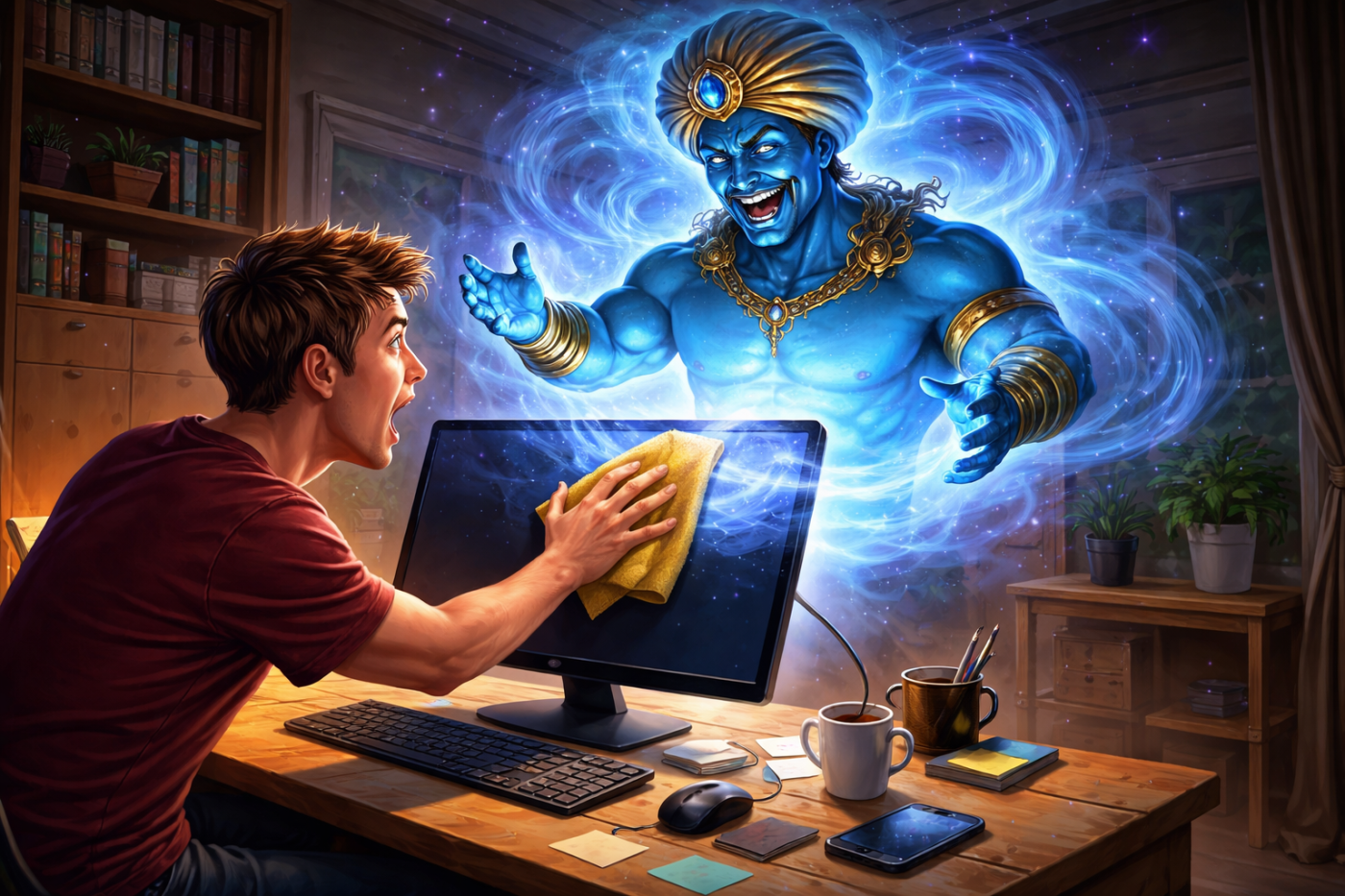
In my opinion, AI will be the genie in the lamp we wished we had never rubbed. Sure, it may have given us what we think we wanted, but I’m afraid our three wishes are up, and we will suffer the consequences we cannot undo.
- The header image created by ChatGPT was used for effect in this particular article ↩︎
- https://www.christianitytoday.com/2025/11/solomon-ray-ai-christian-music-soul-singer/ ↩︎
 Pens & Wrenches
Leave a comment