
In the last article, “We All Have an Assignment“, we examined the Great Commission (Matthew 28:16-20), and Christ’s distributing of our assignments here on earth. Since Christ has all authority over heaven and earth, He told us to do three things as Christians while we are here:
- Make disciples of all nations
- Baptize them in the name of the Father, Son, and Holy Spirit
- Teach them to observe all that I (Jesus) have commanded you
These were commands, not mere suggestions on what to do with our lives as born-again believers of Christ. Thankfully, He left us with His Holy Spirit who helps us, comforts us, and guides what we say and and gives us the words in the moment as we need them, by only trusting that He will provide. As a commanding officer in the military tells his subordinates what needs to be done and it is up to them to decide how to accomplish that, the same goes with Christ. Through the Holy Spirit, we get to choose how that is done.
Today, we are going to dive deep into an area of Scripture about one way we can accomplish the “how”. Turn with me to Luke 10:25-37 as we look at The Parable of the Good Samaritan.
The Lawyer Had Questions
And behold, a certain lawyer stood up and tested Him, saying, “Teacher, what shall I do to inherit eternal life?” He said to him, “What is written in the law? What is your reading of it?” So he answered and said, “‘You shall love the LORD your God with all your heart, with all your soul, with all your strength, and with all your mind,’ and ‘your neighbor as yourself.’ ” And He said to him, “You have answered rightly; do this and you will live.” But he, wanting to justify himself, said to Jesus, “And who is my neighbor?”
Luke 10:25-29 NKJV
Here, a certain lawyer—probably a Scribe—had some questions for Jesus trying to test Him. He asked, “Teacher, what shall I do to inherit eternal life?” Jesus then asked him what was written in the law and what he understood it as. To which the lawyer replied, “You shall love the LORD your God with all your heart, with all your soul, with all your strength, and with all your mind,’ and ‘your neighbor as yourself.”
Jesus responded saying he was correct, and if he did that, he would live. What should have prompted an honest look at himself turned into justifying himself and blurted out, “And who is my neighbor?”
In my cynicism, I can picture Jesus closed His eyes, tilted His head back while pinching the bridge of His nose and mumble: So close. So close. But He didn’t. Instead He tells the lawyer in front of a crowd a parable to help him understand who his neighbor really is.
The Parable of the Good Samaritan
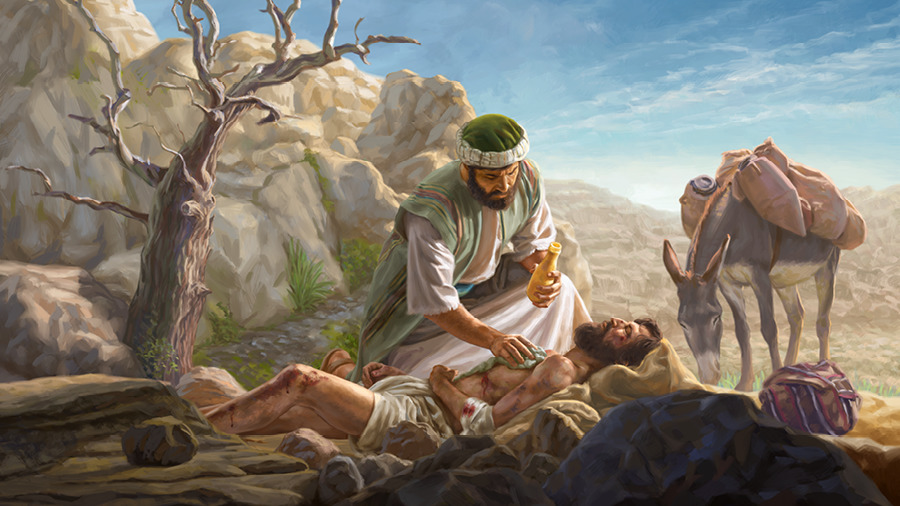
Then Jesus answered and said: “A certain man went down from Jerusalem to Jericho, and fell among thieves, who stripped him of his clothing, wounded him, and departed, leaving him half dead. “Now by chance a certain priest came down that road. And when he saw him, he passed by on the other side. “Likewise a Levite, when he arrived at the place, came and looked, and passed by on the other side. “But a certain Samaritan, as he journeyed, came where he was. And when he saw him, he had compassion. “So he went to him and bandaged his wounds, pouring on oil and wine; and he set him on his own animal, brought him to an inn, and took care of him. “On the next day, when he departed, he took out two denarii, gave them to the innkeeper, and said to him, ‘Take care of him; and whatever more you spend, when I come again, I will repay you.’ “So which of these three do you think was neighbor to him who fell among the thieves?” And he said, “He who showed mercy on him.” Then Jesus said to him, “Go and do likewise.”
Luke 10:30-37 NKJV
As we have seen in another article, that the road from Jerusalem to Jericho was a treacherous path, one with unsuspecting thieves and those looking to do harm. The man no doubt traveled alone, one can only imagine why, and some would even say, “Serves him right for being so stupid.”
But along the road, three people arrive at the scene and see what had happened to the man: a Priest, a Levite, and a Samaritan. The Priest—the modern-day pastor or religious leader, passed by and basically walked around him, all the while most likely made up excuses as to why he couldn’t help. The Levite—the modern-day elder/deacon, the one who assisted the spiritual leader, did the same thing by seeing the man and walking around. These men were “religious” and knew what was right to do, was equipped to do it, but failed to act.
But, the third man—a Samaritan—the modern-day lowest form of a believer, had compassion on the man and took care of him. Like the Priest and Levite, he reacted and saw his neighbor in need, but only he responded. And how did He respond? How are we supposed to respond? We do this in three ways: have compassion, have connection, and stay committed.
Have compassion
Compassion is the compass which drives us to act. It is the motivation to which we are able to act. It’s not that the Samaritan showed mercy to the beat-up man, but that he had mercy to begin with.
When we lose our compassion, we lose our way because get so distracted and disoriented in this life. There are many voices and things vying for our attention. We get turned around on the road to our destination and we need the firm foundation of the earth’s magnetic field to show us where we are and the direction we are heading. With compassion we need the map that never changes, which is God’s Word. We lose our compassion when we become judgmental or rationalize our actions and involvement into helping someone who needs it; and the only way to get back on track is to get our compass and map out to see where we are, where we need to be, and how to get there.
Have connection
The only way to do ministry and help those in need is to have a connection. The Priest and the Levite did not have a connection but were repelled by the man in need. The Samaritan had a connection.
To establish a meaningful connection, one must engage in some way with the suffering of others, whether on an emotional, physical, or spiritual level. We need to touch the pain. Jesus exemplified this connection with the public; He touched the lame (Mark 2:1-12; 3:1-6), the sick (Mark 3:10; 5:25-34; 6:53-56), the lost, the deceased (Mark 5:35-43), the lepers (Mark 1:40-45), the possessed (Mark 1:34; 5:1-20; 9:14-29), and those in poverty (Mark 6:1-44; 8:1-10). Look up the words: “touch/touched” in the Gospel of Mark and you will see an astonishing pattern when it comes to how Jesus reached out to people. But Jesus not only did this, but His disciples after Him and can be witnessed through the letters of Paul and the Acts of the Apostles. Therefore we are to do the very thing: to go into the world and touch the pain of people and shower them with the love of God.
This connection can be either on-going or a one time deal. You could go and pass out tracts, have meaningful conversations with those around you and touch the pain of those who need Christ. I can create a meaningful connection with a person in moments, let’s say on an airplane.
The Samaritan applied oil to soothe the pain and wine to cleanse the wound, placing the individual on his own animal while he proceeded on foot, ultimately ensuring the person’s safety. Establishing a connection and touching the pain necessitates our active involvement in some capacity.
Stay committed
The next day when the Samaritan left to continue his journey, he gave the innkeeper two denarii (two days wages) to finish taking care of the man and then whatever more the innkeeper had to spend, the Samaritan said he would repay. That is staying committed. That’s staying connected. That is being a neighbor to someone in need.
We are called to go into all the world and make disciples, not mere converts. Our mission is to cultivate true followers of Christ who will join us in this transformative pursuit. Staying committed is essential. While we may hand someone a gospel tract and often not see them again, we have the opportunity to enhance the connection by including a card with our number or a sticker on the back of the tract. I prefer to maintain that relationship, but I recognize that it’s not solely my responsibility. I will do everything within my means to make a difference and keep the conversation going.
Jim Mars, guest speaker at CrossTrainers in Des Moines said it best when he said:
“And that’s why Jesus in the midst of it said, ‘Go baptize them.’ Baptism is something you can’t do on your own. You can make a profession of faith on your own, but you can’t baptize [yourself]. …and it’s always done in the context of community. We need each other.”
https://vimeo.com/1147714297
Share the gospel, invite people to church, and keep the conversation going with a coworker, friend, or family member, as every interaction presents a unique opportunity to make a difference. It may be their last moments on the earth, and the impact of your words can resonate far beyond what you might imagine. There are plenty of those in our circle of influence without ever leaving it; thus, we must be mindful of the importance of each connection we have. Take the time to engage in meaningful dialogues, cultivating an environment where they feel safe to allow you to touch their pain and heal them with the oil and wine of the Holy Spirit.
So, as you reflect on Christmas and the love and mercy of God that He showed us by sending His one and only Son and sacrificing Him so that we can have eternal life, think about how you can apply this for the year ahead. I know I needed this reminder—I cannot be the only one.
 Pens & Wrenches
Leave a comment